

Who may carry out inspections? Competence explained
Short answer: who may carry out inspections?
The question "Who may carry out the inspection?" has a clear legal answer - and considerable consequences in practice if it is answered wrongly. An inspection carried out by a person without the required competence is legally worthless: the inspection record is deemed not to have been issued and the work equipment is deemed uninspected.
Inspections and tests must be carried out by a competent person under Decree No. 508/2009 Coll. This is a person with relevant vocational training, proven experience with the type of work equipment being inspected and recent professional activity. For cranes, which count as designated lifting equipment, the rules may additionally require an inspection by an authorised organisation (e.g. TUV).
The competent person under Slovak rules
Decree No. 508/2009 Coll. governs inspections and tests of technical equipment. In practice, three requirements are expected of a competent person at the same time:
Relevant vocational training
The training must enable the person to understand the equipment being inspected. For forklifts this may be a mechatronics or automotive technician; for aerial work platforms a mechatronics technician or agricultural and construction machinery mechanic; for cranes an engineer or technician specialising in crane inspections.
Experience with the work equipment being inspected
The experience must relate to the specific machine type. Someone with experience only of cars is not a competent person for forklift inspections - even if they have the same training background.
Recent professional activity
Activity in the relevant field must be recent - training from the past without current practice is not enough. The term "recent" is not precisely defined; what matters is that the person has also worked hands-on with the type of work equipment in the recent past.
Competent person, crane specialist, authorised organisation: the differences
These three terms are often confused in practice - but they have different meanings and different requirements:
| Term | Requirement | Used for | Typical players |
|---|---|---|---|
| Competent person (Decree No. 508/2009 Coll.) | Training + experience + recent activity | Inspections of most work equipment (forklifts, platforms, construction machinery) | In-house safety technicians, external inspectors with specialist knowledge |
| Crane specialist | Competent person with specific crane knowledge | Regular inspections of cranes as designated lifting equipment | Service fitters, crane specialists |
| Authorised organisation | Accreditation (e.g. TUV) | Tests on certain cranes; greater depth of inspection | Accredited test engineers |
The terms build on each other: every inspector of an authorised organisation is also a competent person, but not every competent person works for an authorised organisation.
Who may inspect which machine?
Forklifts
Inspector: competent person with experience of industrial trucks. An inspection by an authorised organisation is usually not required. Details: Forklift inspections →
Construction machinery
Inspector: competent person with knowledge of the relevant machine class. Details: Construction machinery inspections →
Cranes
Regular inspection: crane specialist (competent person with crane knowledge). Tests on certain crane classes: authorised organisation. Details: Lifting equipment inspections →
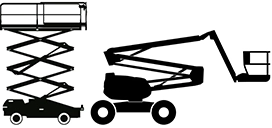
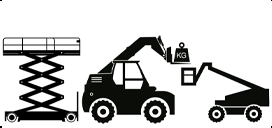
Aerial work platforms
Inspector: certified inspection technician for designated lifting equipment, group A (Decree No. 508/2009 Coll.). Details: Aerial work platform inspections →
Internal or external inspection: decision guide
A competent person can be engaged internally (within your own company) or externally (from an inspection organisation). Criteria:
Internal inspection makes sense if:
- A large in-house fleet and the corresponding qualifications are available
- Inspection staff receive regular further training and are currently active
- Documentation processes are established
External inspection makes sense if:
- The fleet is small or mixed
- No qualified persons are available in-house
- Acquiring the competence is not economical
- The rules require an inspection by an authorised organisation (certain crane classes)
For rental machines from Luibl Rental this decision does not arise: as the lessor, Luibl Rental organises the inspections and supplies all work equipment with a valid inspection.
How do you become a competent person?
Qualification is provided by external, recognised providers - Luibl Rental does not offer training or qualification courses. Possible routes:
- Internal or external seminars at recognised training institutions (e.g. accredited training centres, TUV)
- Training offered by professional and trade associations
- Manufacturer-specific qualification programmes for certain machine classes
Frequently asked questions
Who may carry out an inspection?
A competent person under Decree No. 508/2009 Coll. - with relevant vocational training, experience with the type of work equipment being inspected and recent professional activity. For certain cranes, the rules may additionally require an inspection by an authorised organisation.
Who is a competent person?
A competent person has relevant vocational training, proven experience and recent activity with the work equipment being inspected. Which proof of competence is required is set out in the applicable Slovak safety rules.
May the managing director carry out the inspection personally?
Yes - if they meet the competence requirements under the applicable rules: relevant training, experience with the specific machine type and recent activity. An inspection by a person without these qualifications is legally worthless.
When must an authorised organisation carry out the inspection?
For certain cranes that count as designated lifting equipment, the rules may require tests by an authorised organisation (e.g. TUV) - in addition to the regular inspection. Which equipment requires which inspection is set out in the applicable Slovak safety rules.
Where can you acquire the competence?
From external, recognised training providers: accredited training centres, TUV or manufacturer programmes. Luibl Rental does not offer training or qualification courses.