Spider lift rental - maximum stability on difficult ground
Spider lift rental: 8 tracked platforms from CTE and Teupen with 13 to 39.5 m working height, all with Bi-Energy drive. Request a quote.
Spider lift rental - maximum stability on difficult ground
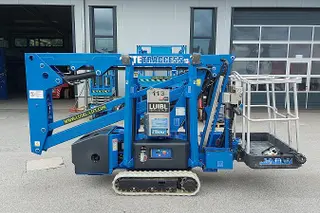
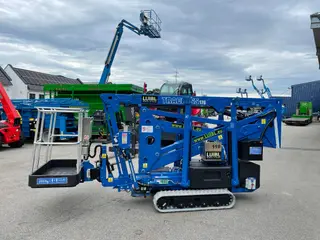
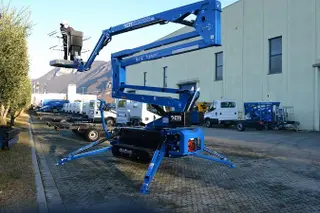
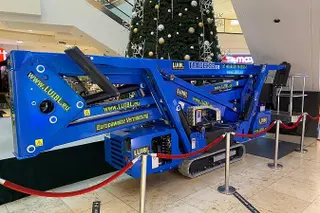
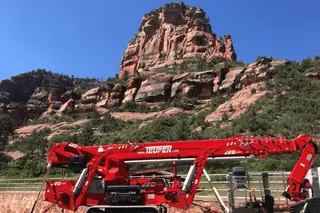
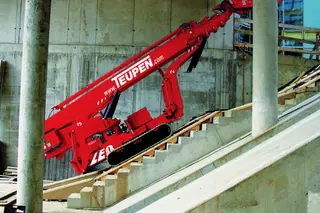
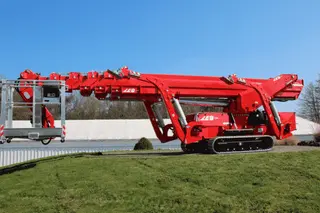
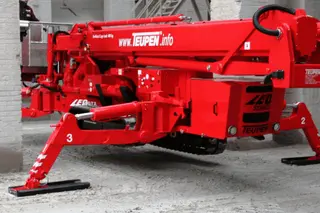
Spider lifts - also known as tracked or crawler platforms - take you where wheels sink in, floors would be damaged or access routes are too narrow. Luibl rents eight spider lifts from CTE and Teupen with working heights of 13.00 to 39.50 m and outreach of up to 17.00 m. All machines have a Bi-Energy drive and are delivered by low-loader to your site. How a spider lift differs from scissor, articulating and telescopic boom lifts is explained in the overview Lift rental - designs compared; all aerial work platforms in our rental fleet can be found under Aerial work platform rental.
Choosing the right machine comes down to three questions: How narrow is the access, how load-bearing is the floor, and how far to the side of the set-up area is the working point? The following sections answer them in turn.
Spider lifts protect sensitive floors and drive where wheels sink in
The tracked chassis distributes the weight of the machine over a large contact area. As a result, ground pressure is significantly lower than with a wheeled chassis - lawns, paving and interior floors remain intact. The rubber tracks generally leave no marks on parquet, natural stone or tiles. Off-road, spider lifts drive over mud, sand and gravel where wheels spin.
For working at height, the machine stands on four fold-out outriggers. These can be levelled individually, so the platform stands level even on slopes, landings or next to flower bed edging.
Key data of our spider lifts:
- Working height: 13.00 to 39.50 m
- Basket load capacity: 200 to 400 kg
- Lateral outreach: 6.50 to 17.00 m
- Travel width retracted: from 0.78 m (CTE TRACCESS 135, 200 and 270)
- Dead weight: 1,600 to 11,900 kg
- Drive: Bi-Energy - combustion engine for outdoor use, electric operation for interiors
Floor protection: every surface needs its own preparation
The tracked chassis protects the floor while driving. When working, however, the load is concentrated on the four outrigger pads. What lies under the outriggers is therefore decisive for damage-free use. Before delivery, clarify which of the following surfaces is present at the workplace:
- Lawns, parks, cemeteries: The tracks distribute the load well along the travel route. Load-spreading plates belong under the outriggers so that the pads do not sink in on damp ground. After longer periods of rain, plan for more plate area.
- Paving, paving slabs, terraces: Individual slabs can break or tip under point loads if the bed underneath gives way. Spreader plates bridge several stones and distribute the outrigger load. Where there are cavities - for example above cellars or utility shafts - check the load-bearing capacity with the owner in advance.
- Interior floors such as parquet, natural stone, tiles and screed: The rubber tracks leave no marks. Place the outrigger pads on protective boards or mats. For floors with underfloor heating, raised floors or old timber beam ceilings, the permitted area and point load must be known before the machine enters the room.
- Gravel, sand, crushed stone, site areas: This is where the tracks show their off-road capability. Place the outriggers on compacted ground or on sufficiently large spreader plates.
- Slopes and steps: The individually adjustable outriggers compensate for inclines. The permitted set-up gradient is stated in the operating manual of the respective machine - we will advise you before you rent.
Dead weight is the most important value for planning: a CTE TRACCESS 135 weighs 1,600 kg, a Teupen LEO40GTX 11,900 kg. Tell us about the ground conditions in your enquiry - we will then recommend the lightest machine that reaches your working height.
Eight spider lifts from 13 to 39.5 m: CTE for narrow access, Teupen for outreach
Our rental fleet is divided into two series with clearly distinct strengths. The CTE TRACCESS models are narrow and light and fit through gates and doorways. The Teupen LEO models reach greater heights and lateral outreach, but are 1.58 m wide.
| Model | Working height | Lateral outreach | Load capacity | Width | Weight |
|---|---|---|---|---|---|
| CTE TRACCESS 135 | 13.00 m | 6.50 m | 200 kg | 0.78 m | 1,600 kg |
| CTE TRACCESS 170 | 17.00 m | 7.50 m | 200 kg | 0.80 m | 2,050 kg |
| CTE TRACCESS 200 | 20.00 m | 8.50 m | 250 kg | 0.78 m | 2,782 kg |
| CTE TRACCESS 270 | 27.00 m | 14.00 m | 250 kg | 0.78 m | 4,350 kg |
| Teupen LEO30T | 30.00 m | 15.70 m | 200 kg | 1.58 m | 4,300 kg |
| Teupen LEO30Tplus | 30.00 m | 17.00 m | 400 kg | 1.58 m | 4,100 kg |
| Teupen LEO35Tplus | 35.00 m | 16.00 m | 400 kg | 1.58 m | 5,400 kg |
| Teupen LEO40GTX | 39.50 m | 16.70 m | 400 kg | 1.58 m | 11,900 kg |
How to read the table:
- Access under 1 m wide: Only the CTE TRACCESS series is an option. With the TRACCESS 270 you can still reach 27 m working height and 14 m lateral outreach through narrow access points.
- Large lateral outreach: From 15 m lateral outreach, Teupen is the way to go. The LEO30Tplus reaches 17.00 m - the largest outreach in the rental fleet.
- Heavy material or two people with tools: The Plus models and the LEO40GTX carry 400 kg in the basket.
- Maximum height: The Teupen LEO40GTX reaches 39.50 m but weighs 11,900 kg. For sensitive floors, first check whether the LEO35Tplus with 35 m and 5,400 kg is sufficient.
Applications: spider lifts are the first choice when access or ground rules out a wheeled machine
A spider lift always pays off when a wheeled aerial work platform cannot reach the workplace or would damage the ground. In practice, there are four such situations:
- Green spaces and tree care: Narrow models from 0.78 m fit through garden gates into backyards and parks. The tracks protect the lawn and root zone, and the lateral outreach brings the basket into the crown.
- Interiors and listed buildings: In churches, museums, halls and shopping centres, the machines work in electric mode without exhaust fumes at the job location. The rubber tracks protect parquet, natural stone and tiles.
- Facades, glass and building services: Glass cleaning, skylights, signage and maintenance work on hard-to-reach exterior facades, even where the building is surrounded by unpaved ground. The slewing superstructure saves repositioning.
- Rough terrain and events: Sites with mud, sand or gravel, slopes, as well as stage and rigging work at events - without anchoring in the ground and without damage to hall floors or lawns.
Heritage conservation example: how to plan a job in a church nave
Listed interiors combine every requirement at once: narrow portals, sensitive floors, no exhaust fumes and working points high above pews or fittings. The following example shows how to plan such a job step by step - for example for inspecting a vaulted ceiling at a height of 16 m.
- Measure the access: The clear width of the portal or side entrance determines the series. With a clear width under 1 m, only a CTE TRACCESS is an option - for 16 m working height the TRACCESS 170 with a width of 0.80 m or, with additional clearance above pews, the TRACCESS 200 with 20 m working height and 8.50 m lateral outreach.
- Clarify floor and loads: Clarify with the heritage authority and the owner what area load the floor can bear and whether there are crypts or cavities beneath it. Plan protective boards for the travel route and spreader plates for the outriggers.
- Determine the set-up point: If pews are in the way, the machine works from the central aisle. The lateral outreach must then bridge the distance to the working point.
- Plan for electric operation: Indoors, the machine drives and works electrically. Clarify where the machine can be charged during longer jobs.
- Coordinate time windows: Services, guided tours and concerts determine the working hours. Allow for set-up and repositioning times and get in touch early.
The same approach applies to museums, palaces, theatres and historic halls.
Safety: operators need a briefing and employer authorisation
Aerial work platforms may only be operated by persons who hold a written confirmation of verified expertise issued by a certified inspection technician (Section 17(3) Decree No. 508/2009 Coll.) and are authorised by their employer. The obligation to carry out a risk assessment and instruction arises from the occupational safety rules (Act No. 124/2006 Coll.) and Government Regulation No. 392/2006 Coll. (work equipment). At handover, we brief your operators on the specific spider lift.
For basic training we recommend an aerial work platform course to IPAF standard. Luibl does not offer training itself; we provide an operator briefing on handover.
Delivery with our own low-loader throughout Slovakia
Spider lifts are not approved for road use. Luibl therefore delivers them with its own low-loader directly to the job location - throughout Slovakia. The transport weight ranges from 1,600 kg for the CTE TRACCESS 135 to 11,900 kg for the Teupen LEO40GTX and helps determine the vehicle and costs. Please therefore let us know what the access is like and where the low-loader can unload.
If the ground is paved and the working point is freely accessible, wheeled machines are often the more economical choice: articulating boom lifts for working over obstacles and telescopic boom lifts for great heights.
How much does it cost to rent a spider lift?
Spider lifts cost more to rent than comparable wheeled machines - the tracked chassis, variable outriggers and rubber tracks are more complex. The machine becomes economical where an alternative could not be used at all or where floor protection would otherwise come at a high price.
These factors determine the rental price:
- Working height and outreach: Between a 13-metre machine for indoor use and a 39.5-metre spider lift there are several classes. With up to 17 m of outreach, reach often matters more than height.
- Model range: The narrow CTE TRACCESS models for tight access points, the Teupen LEO models for long outreach and 400 kg basket capacity.
- Rental period: Daily, weekly and monthly rates are tiered; for longer projects, long-term terms apply, including maintenance and inspections during the rental period.
- Transport: Delivery and collection by low-loader to your site are shown separately, based on transport weight and access.
If the ground has sufficient bearing capacity and the work point is freely accessible, also consider the more affordable alternatives: a scissor lift for purely vertical work or a wheeled articulating boom lift. All types at a glance: Aerial work platform rental.
FAQ: Spider lifts

Which surfaces is a spider lift best suited for?
Do spider lifts fit through normal doors?
How does stabilisation work on uneven ground or stairs?
Does Luibl deliver the spider lift directly to the site?
Is a spider lift the same as a crawler platform?
Which spider lift has the largest outreach?
Do I need a special operator card for spider lifts?
Which spider lift carries 400 kg in the platform?
Do the spider lifts have a drive with zero local emissions for indoor use?
Request a spider lift now
Send us the working height, the lateral distance to the work point, access width, ground conditions, job location and rental period via our contact form - you will promptly receive a binding quote.