Heavy-duty forklift rental – powerhouses for industry and cargo handling
Rent Kalmar and Hyundai heavy-duty forklifts: 8 to 33 t load capacity, diesel or electric, delivery throughout Slovakia. Request a quote.
Heavy-duty forklift rental – powerhouses for industry and cargo handling
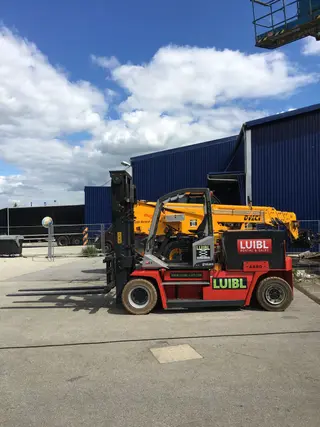
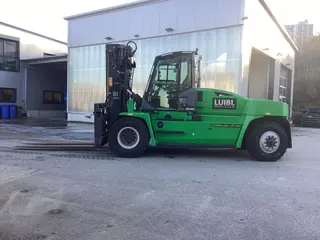
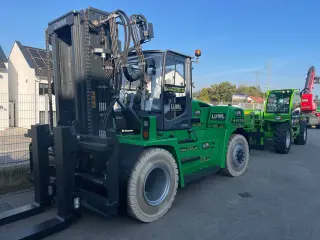
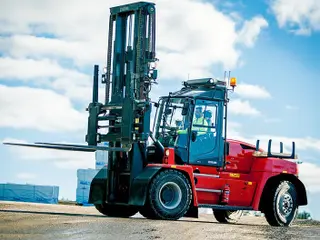
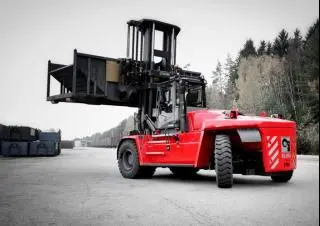
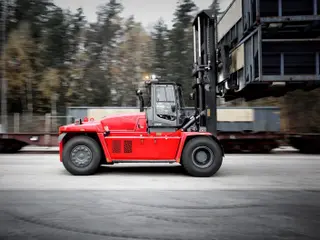
When loads over 8 tonnes have to be moved regularly, a standard counterbalance forklift is no longer enough. Heavy-duty forklifts have reinforced masts, more powerful hydraulics and greater stability – designed for steel construction, precast concrete elements, machine components and container handling. At Luibl, you rent heavy-duty forklifts from Kalmar and Hyundai with load capacities from 8 to 33 tonnes. Delivery throughout Slovakia with our own low-loader fleet.
When is a heavy-duty forklift the right choice?
The threshold for a heavy-duty forklift lies where standard industrial forklifts (usually up to 5 tonnes load capacity) reach their rated capacity. Projects in the metal industry, precast concrete production, steel processing or port handling regularly work with loads between 8 and 18 tonnes – here a heavy-duty forklift is a must, not an option.
Typical applications:
-
Metal and steel construction: loading steel beams, coils, prefabricated parts and semi-finished products. With these goods, the load centre is often far in front of the fork tips – which reduces the residual capacity and requires an appropriate rated design.
-
Precast concrete and building materials industry: transporting precast concrete elements, natural stone blocks and heavy pallets. Often on unpaved plant premises with slopes and access roads.
-
Port and transhipment terminals: loading and unloading trucks, wagons and containers. Here, heavy-duty forklifts often replace the reach stacker in the second handling row.
-
Machine tool manufacturing and heavy industry: in-plant transport of machine assemblies, moulds and press parts. Operation often takes place on hall floors with a defined load-bearing capacity.
-
Recycling and timber industry: handling steel scrap, logs and paper bales. High stress due to continuous operation and rough loads.
The decision for a heavy-duty forklift does not depend on weight alone. The load centre, lift height, fork length and the floor load capacity at the site also determine which machine fits.
Our rental fleet: load capacities from 8 to 33 tonnes
In the heavy-duty category, Luibl covers the 8 t, 10 t, 16 t and 18 t capacity classes with six specific models. The focus is on Kalmar – the global reference in the heavy-duty forklift segment – complemented by Hyundai and EP.
The entry class: 8 to 10 tonnes
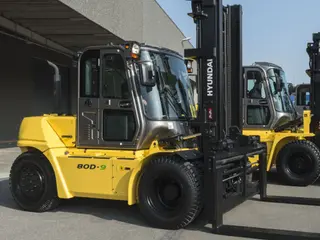
Hyundai 80D-9 (8 t diesel): The diesel drive is the classic choice for outdoor areas and mixed indoor/yard operation. With a fork length from 6,000 mm and a rated capacity of 8 tonnes, the Hyundai 80D-9 covers typical heavy-duty tasks in steel trading and at recycling yards.
Kalmar ECF 80-9 (8 t electric): For indoor operation with emission requirements – for example in the food industry, pharmaceutical production or paper processing. The electric drive works with no local emissions and significantly more quietly than comparable diesel machines. 8 tonnes load capacity at 3,450 mm lift height.
EP EFL 1002 (10 t electric): The next step in the electric version with 10 tonnes load capacity and 5,000 mm lift height. Demand for electric heavy-duty forklifts is rising significantly – both for emission reasons and because of lower operating costs in continuous use.
The heavyweights: 16 to 33 tonnes
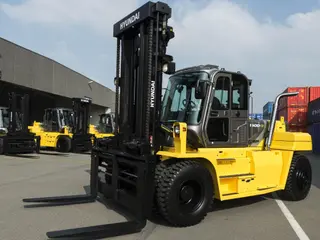
Hyundai 160D-9 (16 t diesel): 16 tonnes load capacity at 4,500 mm lift height. Typical use in plant handling, container loading or heavy pallets outdoors. Robust diesel drive technology designed for continuous operation.
Kalmar DCG 160-12T (16 t diesel): Kalmar is regarded as the world market leader in heavy-duty forklifts. The DCG 160-12T works with 16 tonnes load capacity at 4,500 mm lift height and a load centre distance of 1,200 mm – relevant for precast concrete elements and large-format loads. A rear camera, an ergonomic workplace and an optimised cylinder arrangement improve forward visibility.
Kalmar DCG 180-6T (18 t diesel): The top rental model: 18 tonnes at 4,500 mm lift height, load centre 600 mm. The shorter load centre shows that this machine is designed for compact, very heavy loads – steel blocks, press moulds, tools. Despite the high rated capacity, the dimensions remain manageable; the turning radius allows use in factory halls with normal traffic areas.
For even higher loads: Luibl also rents out the Manitou MHT 10200 heavy-duty telehandler with 20 tonnes load capacity. Formally, this machine is not a counterbalance forklift but belongs to the telehandler category; in return, it reaches greater lift heights and more outreach. The MHT is the first choice when classic counterbalance forklift geometry is not sufficient.
Key factors when choosing your rental forklift
Choosing a heavy-duty forklift comes down to five technical parameters. Anyone who does not clarify them properly risks a machine that is either oversized at the site or – more dangerously – undersized.
Rated capacity and load centre: The load capacity stated on the rating plate always applies to a defined load centre distance – usually 600 mm or 1,200 mm. If the load is picked up further forward, the residual capacity sometimes drops drastically. Precast concrete elements, steel plates and bulky machine assemblies often have significantly longer load centres. What counts here is the load chart of the specific machine – not the capacity figure in the brochure.
Lift height and overall height: Besides the actual lift height (maximum distance of the fork level from the floor), the overall height of the mast when retracted is relevant. Door heights, roof structures of halls and passages between production areas define the upper limit. A free-lift mast allows lifting without extending the mast – important in halls with limited ceiling height.
Fork length: Standard forks on 8 t forklifts are 1,200–1,500 mm, on 16–18 t models 1,800–2,500 mm. Longer forks are needed for coils, large pallets and long goods. Luibl offers suitable accessories for rent: fork extensions, coil rams, load backrests.
Drive type: Diesel delivers torque and continuous power for outdoor use. Electric is a must in emission-sensitive environments and plays to its strengths in multi-shift indoor operation. For mixed operation, the industry also offers bi-energy models – the Luibl heavy-duty portfolio currently includes diesel and electric versions.
Ground conditions: An 18-tonne forklift itself weighs around 25 to 30 tonnes even when empty. Then comes the load. The floor load capacity at the site – hall, ramp, outdoor area – must be checked before delivery. Luibl helps with the assessment; the limit values can be found in the machine's data sheet under point load per wheel.
Logistics without limits: delivery throughout Slovakia and service
Transporting a heavy-duty forklift is a logistics project in itself. With dead weights from 15 to over 25 tonnes and widths over 2.5 metres, only heavy-duty low-loaders come into question – often with a special permit for the transport route.
Luibl operates its own low-loader fleet, designed precisely for these requirements. This makes delivery independent of external forwarders and reduces the risk of rescheduling. For the rental period, this means plannable delivery dates, defined collection and – if necessary – prompt replacement in the event of technical faults.
The delivery area includes: Slovakia, Germany, Austria, Switzerland, Poland, Czechia, Italy, Hungary and other European countries. For locations with port or plant connections – such as Bratislava, Kosice, Zilina or the industrial regions around Trnava, Nitra and Trencin – we deliver promptly.
During the rental:
-
Technical support on site: If required, Luibl sends a service technician directly to the site or plant. This minimises downtime caused by operating errors or technical problems.
-
Long-term rental terms: For projects lasting several months, inspections and tests of technical equipment (Decree No. 508/2009 Coll.) and regular maintenance are included in the contract.
-
One contact person: for heavy-duty forklifts, telehandlers, aerial work platforms and standard forklifts – no parallel contracts with different rental companies.
FAQ: Heavy-duty forklift rental

Can I rent a heavy-duty forklift for just a few days?
How much does it cost to rent a 10-tonne forklift?
What qualification does the driver of a heavy-duty forklift need?
How is the delivery of a heavy-duty forklift organised?
Which attachments are available for heavy-duty forklifts?
Maximum safety in heavy-duty rental
As industrial trucks, heavy-duty forklifts are subject to occupational safety rules (Act No. 124/2006 Coll.) and Government Regulation No. 392/2006 Coll. (work equipment). This results in specific obligations for operators and hirers.
Inspections and tests: All Luibl rental machines are inspected according to FEM 4.004 – with a focus on the hydraulic system, mast, lifting frame, brakes and safety devices. The inspection sticker is clearly visible on every machine. For long-term rentals, Luibl carries out inspections and tests of technical equipment in line with the manufacturer's instructions and applicable Slovak safety rules during the ongoing rental.
Daily check by the driver: A visual and functional check is required before every shift – tyres, oil level, hydraulic lines, lighting, warning devices. Luibl provides the corresponding checklist on handover.
Briefing on handover: For complex machines – especially from 16 tonnes load capacity – Luibl staff provide a personal operator briefing on request. This covers the load chart, operating concept, safety devices and the specifics of the particular model.
Workplace risk assessment: Under occupational safety rules (Act No. 124/2006 Coll.), responsibility for the risk assessment lies with the operator of the site. The rental company supplies the technical documentation; the site-specific assessment – for example of floor load capacity, travel routes and load pick-up – must be carried out by the company itself.
Drivers need the required operator competence (forklift operator licence); in addition, Luibl provides an operator briefing on handover.
Request a no-obligation quote for your heavy-duty forklift now
Choosing the right heavy-duty forklift is not a catalogue click but a planning question: load capacity, load centre, lift height, drive, ground conditions and rental period all interact. A consultation with Luibl brings the right machine to your site – including low-loader logistics, inspections and tests, and technical support throughout the rental period.
Contact:
-
Phone: 00800 2000 3000 (toll-free) · +49 (0) 851 756868-0
-
Email: [email protected]
-
Online enquiry: www.luibl.eu/kontakt/