Truck-mounted platform rental - flexibility for work at height
Truck-mounted platform rental: category B up to 22 m, large units up to 57 m, Ruthmann and Palfinger, fully inspected. Request a quote.
Truck-mounted platform rental - flexibility for work at height
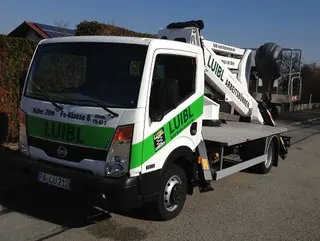
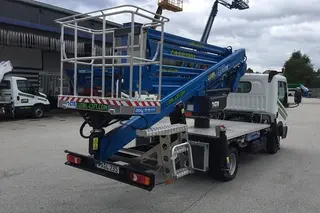
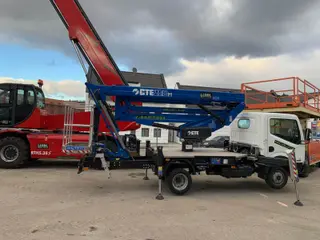
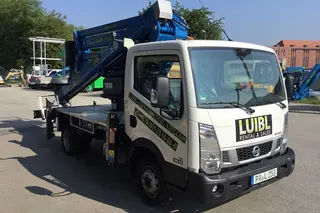
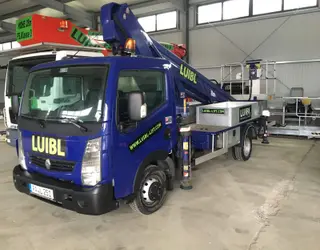
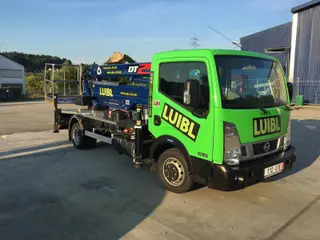
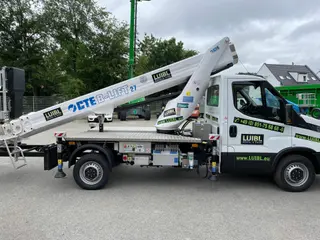
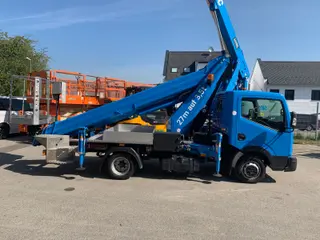
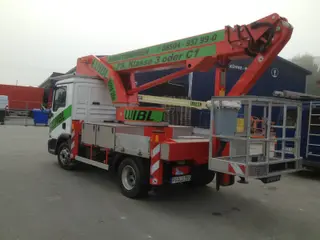
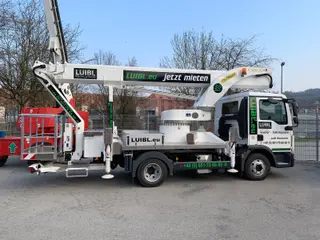
A truck-mounted platform brings working height straight to the job: no low-loader transport, no set-up area, no advance preparation. The platform drives up, deploys its outriggers and raises the basket. For church tower renovation, street lighting, tree pruning in public spaces or large installations up to 57 metres, this is the decisive operational advantage over stationary work equipment. Luibl rents truck-mounted platforms from 16 m to over 50 m working height - fully inspected, from brands such as Ruthmann and Palfinger, with delivery throughout Slovakia. Whether a truck-mounted platform or a self-propelled design is the better choice is explained in the overview Lift rental - which platform for which job; all aerial work platforms in our rental fleet can be found under Aerial work platform rental.
Why rent a truck-mounted platform? The advantages
Truck-mounted platforms differ from self-propelled aerial work platforms in one key respect: they are road vehicles. This means:
High mobility between job sites: A truck-mounted platform can move from site A to site B during the lunch break. For municipal services that visit several light points or tree locations every day, this is the decisive economic factor compared with stationary machines.
Fast automatic set-up: Modern truck-mounted platforms deploy their outriggers automatically at the push of a button. Set-up times of under five minutes are standard - no manual rigging, no separate set-up person.
Large lateral outreach: Truck-mounted platforms from 20 m working height achieve lateral outreach of 12 m and more. This gives access to work areas that self-propelled machines could only reach by repositioning several times - for example facade work over hedges, fences or parked vehicles.
Below-ground operation: Certain truck-mounted platform models can swing the boom below the set-up level. For bridge undersides, retaining walls and slopes, this is the only technically safe solution that requires no special equipment.
Our truck-mounted platform categories in the Luibl rental fleet
Truck-mounted platforms up to 3.5 t - category B licence
The light class of truck-mounted platforms is built on carrier vehicles with a gross vehicle weight of up to 3,500 kg. A category B licence is sufficient for operation - no truck licence, no driver card, no restrictions from driving and rest times under EU driver rules.
Technical specifications of this class:
-
Working height: 16 m to 22 m
-
Lateral outreach: up to 11 m
-
Basket load: 200 kg to 230 kg
-
Carrier vehicle: van or light truck up to 3.5 t GVW
-
Outrigger span: variable, typically 4.5 m to 5.5 m - spreader plates required on soft ground
Applications:
-
Street lighting maintenance by municipal works departments
-
Facade and painting work on buildings of up to three storeys
-
Tree pruning and tree care in public green spaces
-
Signage and sign installation in commercial areas
-
Electrical installation on building facades and hall roofs
The category B platform is particularly relevant for trade businesses and municipal bodies that do not have, or do not want to keep, a truck licence holder in the team. The vehicle is driven like a normal van - with the licence the employees already hold.
Large truck-mounted units - category C / C1 licence
Above a gross vehicle weight of 3,500 kg, a category C1 licence (up to 7.5 t) or C licence (over 7.5 t) is required. This class is aimed at projects where working height and outreach exceed the limits of the light class.
Technical specifications of the large-unit class:
-
Working height: 30 m to 57 m and above
-
Lateral outreach: up to 30 m on large units
-
Basket load: up to 300 kg (two-person operation)
-
Outrigger span: up to 8 m - must be on load-bearing ground or with spreader plates
-
Below-ground operation: available on several models (boom can swing below set-up level)
Practical example: A 57 m large unit was used for a church tower renovation in Passau. The variable outrigger configuration enabled a standard-compliant set-up with maximum stability despite extremely tight space on the market square - a stationary solution would not have been feasible on this ground and plot layout.
Applications of the large-unit class:
-
Church towers, industrial chimneys, silos
-
Bridge inspection and bridge maintenance
-
Installation of wind power ancillary systems and line infrastructure
-
Building construction installations in industrial construction
-
Stage rigging and sound systems at major events
What driving licence do I need for a truck-mounted platform?
The licence requirement depends solely on the gross vehicle weight of the carrier vehicle, not on the working height of the platform:
-
Category B (up to 3,500 kg GVW): Sufficient for all truck-mounted platforms in the light class. No logbook entry, no driver card requirement.
-
Category C1 (3,501 kg to 7,500 kg GVW): Required for medium truck-mounted platforms. Under EU law, C1 holders need a driver card for journeys over 100 km.
-
Category C (over 7,500 kg GVW): Mandatory for large units from 30 m working height upwards.
Regardless of the licence category, the following applies to operating the platform itself: the operator must be demonstrably briefed and hold a valid operator certificate (Section 17(1)(b) Decree No. 508/2009 Coll.). A driving licence for the carrier vehicle does not replace the briefing on platform operation. Luibl carries out a documented operator briefing at every handover.
What do I need to consider when setting up in public spaces?
Using a truck-mounted platform on public roads, pavements or squares is subject to road traffic rules (Act No. 8/2009 Coll. on road traffic). The following points must be clarified before use:
Set-up permit: Using public traffic areas as a set-up location generally requires a permit from the competent authority. Processing times vary by authority - apply early.
Traffic safety and barriers: The set-up area must be secured in line with the applicable rules for marking work zones on roads. Proper barriers, warning lights and, where necessary, traffic signs are the operator's responsibility - not Luibl's task, but we can coordinate them on request.
Ground and load-bearing capacity: On pavements, paved and grassed areas, the load-bearing capacity of the ground must be checked before deploying the outriggers. On soft ground or where the capacity is unknown, spreader plates (min. 1 m x 1 m per outrigger) are mandatory. Luibl recommends ordering spreader plates as standard with every truck-mounted platform rental.
Wind speed: Safe operation of truck-mounted platforms is limited to a maximum wind speed of 12.5 m/s (Beaufort 6) - in accordance with STN EN 280. Operation must stop when weather conditions exceed this limit. For work at heights above 40 m, local wind measurements are recommended, as wind speed increases with height.
Top brands in the Luibl rental fleet: Ruthmann and Palfinger
Ruthmann: Ruthmann truck-mounted platforms are the standard in Germany for municipal and commercial use. The Ruthmann mast system is designed for high duty cycles - engineered for durability rather than minimum weight. The basket controls respond proportionally and precisely, which matters for facade work with tight tolerances. Ruthmann models cover working heights from 16 m to 57 m.
Palfinger: Palfinger aerial work platforms are known for their small footprint when deploying the outriggers. Compact outrigger spans allow use on streets with parking on both sides without fully closing the opposite lane. This makes Palfinger models the preferred choice for urban jobs with limited set-up space.
Both brands are regularly maintained in the Luibl rental fleet and undergo inspections and tests of technical equipment (Decree No. 508/2009 Coll.) before every delivery. The inspection record is available at handover.
Insurance cover for truck-mounted platform rentals
All truck-mounted platforms are covered for third-party damage in road operation under the motor liability insurance of the carrier vehicle. For damage to the rented machine itself (machinery damage, accident damage during operation), machinery breakdown insurance with an excess is required. This can optionally be included in the rental agreement with Luibl.
In the event of damage: report it to Luibl immediately, make no unauthorised repair attempts, and wait for an initial assessment by a Luibl technician on site.
Rent truck-mounted platforms from Luibl - full service
Luibl delivers truck-mounted platforms throughout Slovakia as well as to Germany, Austria, Switzerland, Poland, Czechia, Italy, Hungary and other European countries. We arrange dates with you promptly.
Request a quote via our contact form: state the working height, job location, rental period and the operator's licence category. For projects requiring a set-up permit in public spaces, get in touch early so that the delivery date and the permit process can be coordinated.
