Industrial trucks: technology, applications and selection
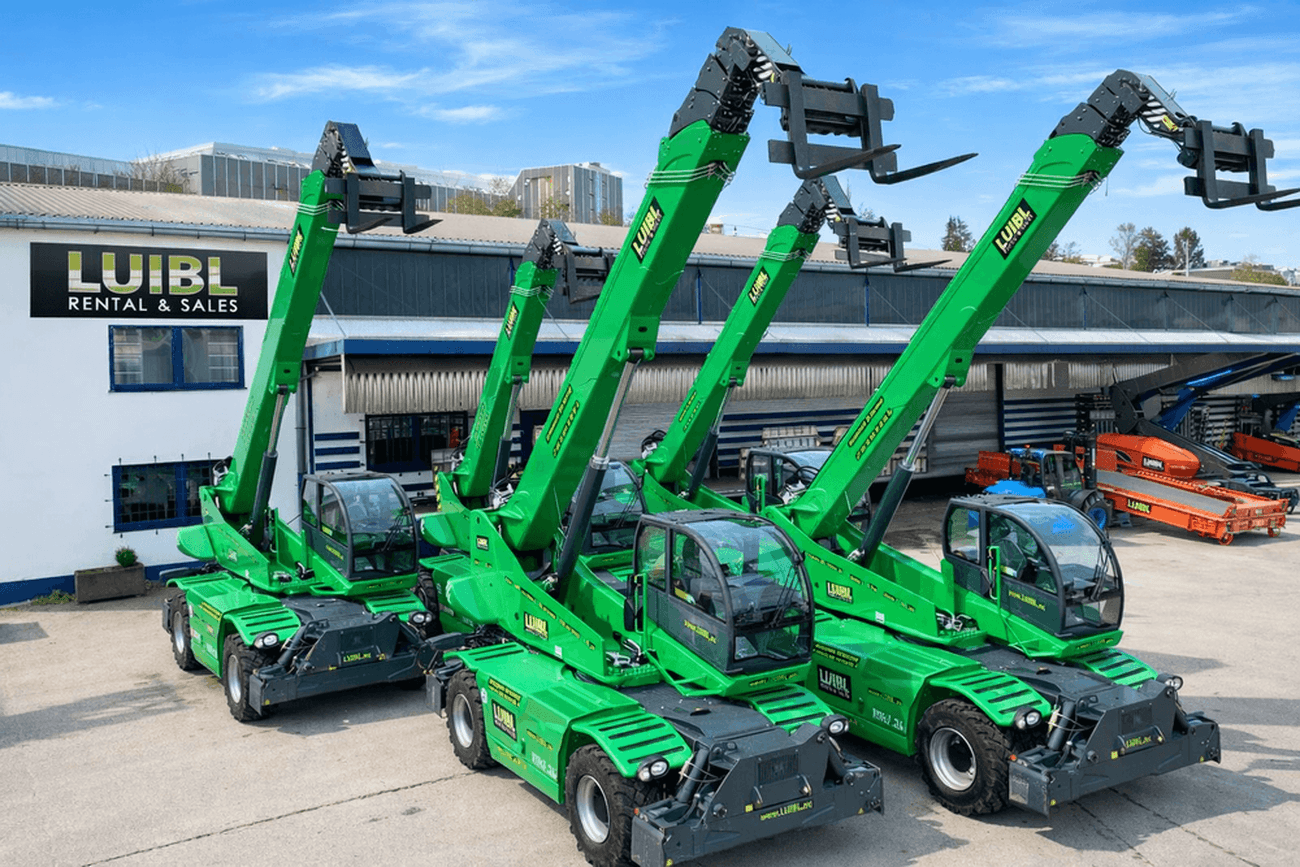
Industrial truck is the generic term standardised in ISO 5053 for floor-bound conveyors that are not guided by rails. It covers forklifts of all designs, high-lift trucks, reach trucks, pedestrian stackers, rough-terrain forklifts and telehandlers. In everyday language, "industrial truck" and "forklift" are often used synonymously - technically, the forklift is a subgroup. This guide explains the individual designs, the legal framework under occupational safety rules (Act No. 124/2006 Coll.) and Government Regulation No. 392/2006 Coll. (work equipment), and the selection criteria that really make the difference in practice. It is aimed at dispatchers, site managers and buyers preparing a purchase or rental decision.
What Luibl covers in the industrial truck segment
The Luibl rental fleet covers all relevant designs from the electric pedestrian stacker to the heavy-duty telehandler Manitou MHT 10200 with 20 t load capacity. We rent classic forklifts in diesel, electric and LPG versions with up to 16 t load capacity. Delivered by low-loader to your site, throughout Slovakia.
Not in our range: automated guided vehicles (AGV). Although these are technically also covered by the safety rules for work equipment, they are not operator-driven industrial trucks and are not part of our rental fleet portfolio.
Designs in detail
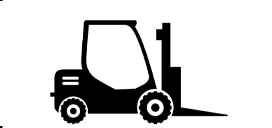
Counterbalance forklift By far the most common design. The counterweight at the rear balances the load on the forks. Universally applicable, from the 1.5-tonne warehouse truck to the 16-tonne heavy-duty forklift.
Distinction by drive: Electric forklifts are suitable for indoor areas, food logistics, pharmaceuticals, cold stores and anywhere exhaust fumes or noise must be ruled out. Modern lithium-ion machines now manage single-shift operation without a battery change. Outdoor use in wet and cold conditions remains a weakness: if machines stand outside in sustained frost, battery life is noticeably shortened.
Diesel forklifts are the robust choice for outdoor use, construction sites and heavy loads. All current Luibl rental machines meet the EU Stage V emission standard. Diesel machines are ruled out in enclosed halls - the workplace exposure limits under the safety rules cannot be met without elaborate ventilation.
LPG forklifts are the classic compromise: lower emissions than diesel, more powerful than electric, and permitted in well-ventilated halls. In practice they are ordered less often than before because electric technology has caught up.
Reach truck The lifting mast can be retracted between the wheel arms. This eliminates the large counterweight, making the machine more compact and able to drive in narrower aisles. Typical use: high-bay warehouses with aisle widths under 3 m and rack heights up to 13 m. Available exclusively as an electric version.
Pedestrian stackers and high-lift trucks Low-lift pedestrian trucks transport pallets close to the ground, typically for order picking and goods receiving. The operator walks alongside or rides on a step platform. High-lift trucks are pedestrian-guided machines with a lifting mast of up to several metres - an intermediate solution between a pure transport device and a counterbalance forklift. They make sense in companies that regularly store goods on two to three rack levels but do not have the volume to justify a full forklift.
Rough-terrain forklift Robust design with off-road tyres, increased ground clearance, often four-wheel drive. Essential as soon as the place of use is unpaved - construction sites, timber yards, building materials yards, agriculture. A normal counterbalance forklift with SE solid rubber tyres fails on soft ground and gets stuck; this is a common reason for expensive emergency re-orders.
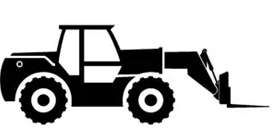
Telehandler Combines the forklift with an extendable telescopic boom. Achieves significantly greater lift heights and outreach than conventional forklifts. By changing attachments (forks, bucket, work basket, winch, concrete skip), they often replace three individual machines on site.
- Fixed telehandlers: fixed superstructure, classic construction machine profile, lift heights up to about 20 m.
- Roto telehandlers: 360° rotating superstructure. Luibl offers Magni RTH and Manitou MRT - lift heights up to 39 m, usable at Luibl with an attachment change as an aerial work platform (basket) or crane (winch).
- Heavy-duty telehandlers: Manitou MHT 10200, 20 t load capacity - used for industrial installations, heavy machinery relocation, wind energy.
Heavy-duty forklift A separate category from about 8 t load capacity. Typical applications for Luibl customers: metalworking (coils, beams, sheet metal packs), container handling, tool and mould transport in the automotive industry. Forklifts up to 16 t are regularly available in the rental fleet.
In practice: when does buying pay off compared to renting?
The honest rule of thumb from rental fleet dispatch: below 1,200 operating hours per year, renting almost always works out better. In between - 1,200 to 1,800 hours - it is a trade-off that depends on interest rates, maintenance costs and flexibility requirements. From about 1,800 operating hours per year, the forklift is effectively running in two-shift operation and buying becomes economical.
What is often overlooked: the operating hours calculation only applies if the requirement profile remains stable over the holding period. If the hall layout, product mix or racking technology change regularly, renting remains the clean solution - even with high utilisation. A purchased forklift that no longer fits is a millstone; a rental machine can be promptly swapped for another one.
In practice: telehandler instead of mobile crane - when?
Telehandlers with a winch replace a mobile crane on many construction sites. This works reliably if:
- lifting loads are below the rated load capacity of the telehandler - at the required outreach, not at the nominal value. The load chart of the telehandler drops steeply with increasing outreach.
- the site has a load-bearing standing area (telehandler supported on outriggers or on wheels with a level base).
- the lifting frequency is low to medium. For series lifts, the mobile crane is still faster.
Not sensible: lifts close to the load capacity limit, lifts over obstacles with large outreach, and in principle lifting work involving people - that is then a job for an aerial work platform, not a crane. A roto telehandler is sufficient for 80% of site lifts. The remaining 20% should be honestly calculated with a mobile crane company, not with an overloaded telehandler.
FAQ: frequently asked questions about industrial trucks
What is the difference between a forklift and an industrial truck?
Industrial truck is the generic term under ISO 5053. Forklifts are the best-known, but not the only subgroup.
What qualification does the driver need?
A forklift operator licence (Act No. 124/2006 Coll., Decree No. 356/2007 Coll.), issued by an authorised training provider, and an authorisation from the employer; plus regular safety briefing of employees under Section 7 of Act No. 124/2006 Coll. Luibl provides an operator briefing on handover for all machine types in the rental fleet.
How often does a forklift have to be inspected?
Regular inspections are carried out in line with the manufacturer's instructions and applicable Slovak safety rules. For Luibl rental machines, these inspections are included in the rental.
How much does it cost to rent a forklift?
Long-term rental of a standard forklift EUR 30-80/day, short-term rental EUR 10-25/h. The exact calculation depends on design, load capacity, rental period and place of use.
Is a work basket on a forklift permitted?
Only for short-term, occasional work with a firmly attached, approved attachment. For regular work at height, an aerial work platform is required.
Does Luibl deliver at weekends?
Yes, with its own low-loader fleet. Collection on Friday and return on Monday at the daily rate is possible depending on the location - please send your enquiry directly to dispatch.
Which countries does Luibl deliver to?
Slovakia, Germany, Austria, Switzerland, Poland, Czechia, Italy, Hungary and other European countries.