Rent or buy an aerial work platform? The decision by utilisation, costs and duties
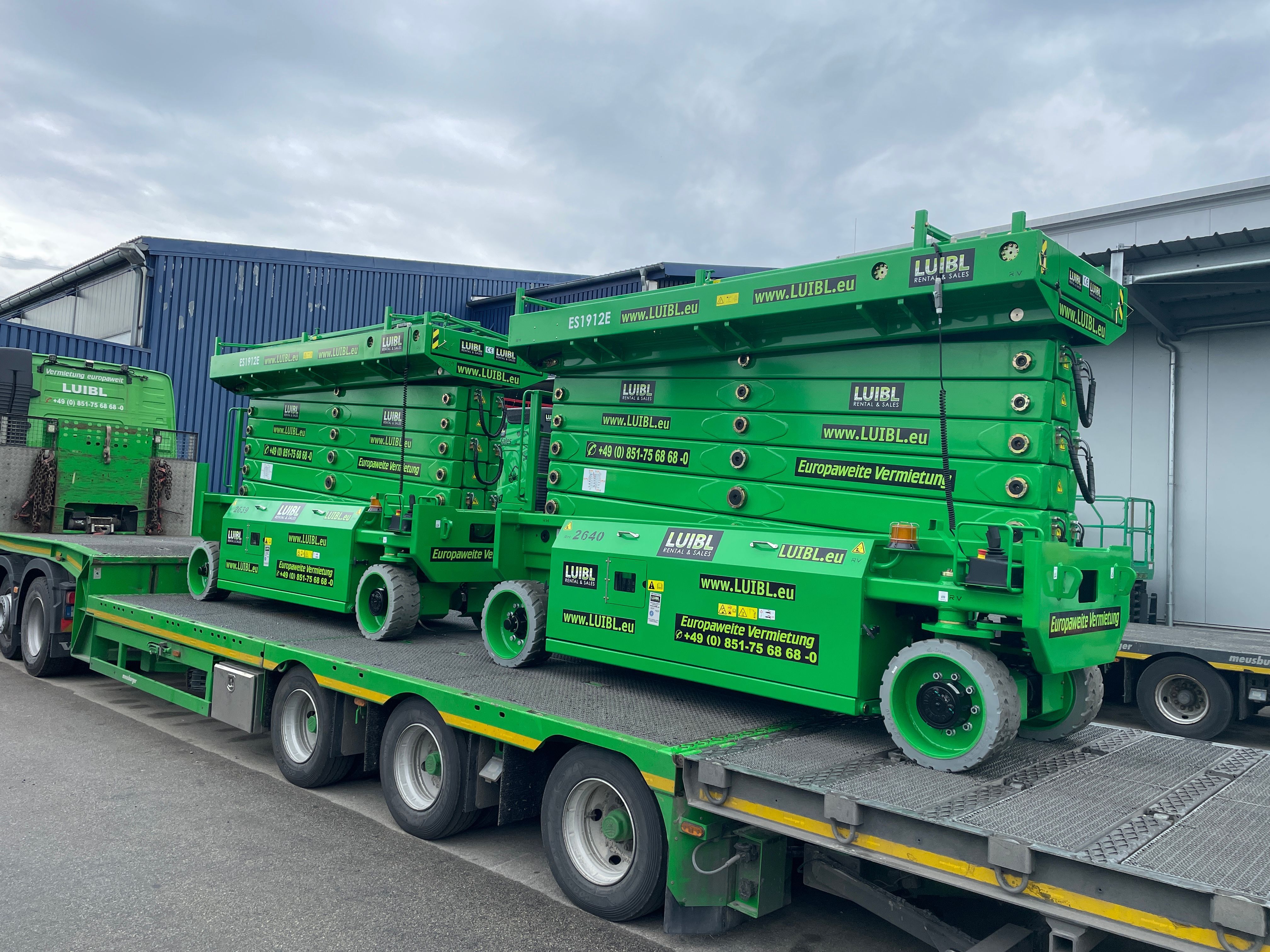
Whether you should rent or buy an aerial work platform depends above all on utilisation: below around 150 days of use per year, renting is usually more economical; from around 250 days of use, buying can pay off. In between, three points tip the balance — how many different types you need, who organises inspections, tests and maintenance, and how much capital you want to tie up.
Many companies eventually face the question: the rented aerial work platform was in use a lot this year and the rental invoices are adding up — would a machine of your own be cheaper? The honest answer depends on what costs arise besides the purchase price and whether the one machine you buy really covers all jobs. This guide shows the calculation, the owner's costs and the mixed models in between.
Luibl knows both sides: Luibl Rental rents out aerial work platforms with delivery throughout Slovakia, and new and used machines are sold via luibl.net. You will find all rental machines on the page Aerial work platform rental.
Utilisation decides: below around 150 days of use, renting an aerial work platform usually pays off more than buying
A machine you have bought costs money even when it is idle. A rented one only costs money while it is working. This gives the basic rule: the more often and the more evenly a machine is needed over the year, the sooner buying pays off.
Experience from the rental business shows three zones:
- Below about 150 days of use per year: Renting is generally cheaper. This applies to most construction, trade and installation companies that need a platform for individual projects.
- About 150 to 250 days of use: The decision depends on the machine class, purchase price and owner's costs. A detailed calculation is worthwhile here.
- Above about 250 days of use: A machine that works almost every day at the same location — for example in plant maintenance — can pay off when owned.
Count only actual days of use of the same type and height class. Twenty days with a 10-metre scissor lift and thirty days with a 26-metre articulating boom lift are not fifty days for one machine.
Anyone who buys an aerial work platform bears five cost blocks besides the purchase price
The purchase price is only the visible part. These five items belong in every comparison calculation:
1. Tied-up capital and depreciation
The money for the machine is no longer available for other investments. In addition, there is the annual loss of value, which you depreciate over the service life.
2. Inspections, tests and maintenance
An aerial work platform is designated lifting equipment, group A (Decree No. 508/2009 Coll.). It requires an inspection once a year and a test every two years by a certified inspection technician (Decree No. 508/2009 Coll., Annex 7), unless the manufacturer specifies shorter intervals. On top of this come maintenance according to the manufacturer's specifications, wear parts, batteries for electric machines and repairs. When renting, the rental company takes care of this — when buying, the owner does.
3. Transport
A machine of your own has to be taken to every site. Anyone without a suitable low-loader pays for transport anyway, just to a haulier instead.
4. Insurance and storage
Machinery insurance, a secure parking space and, for electric machines, a charging space in winter.
5. Downtime and the wrong type
The platform you bought does not suit every job. It then stands in the yard while another machine is rented for the job anyway. In practice, this is the biggest hidden cost block.
Renting provides the right aerial work platform for every job – without organising inspections and storage
The biggest advantage of renting is not the price per day but the choice. A company that works in a hall one day and on a facade the next does not need one platform but several. The Luibl rental fleet includes scissor lifts from 6.30 to 34 m, articulating boom lifts up to 48.15 m, telescopic boom lifts up to 56.90 m as well as mast lifts, spider lifts and truck-mounted platforms — always the machine the job requires. Which type suits which task is explained in the decision guide Which aerial work platform for which job?
On top of that, there is what you do not have to organise when renting:
- Inspections and tests: Every rental platform is handed over with a valid inspection and test record.
- Transport: Luibl Rental delivers the machines by its own low-loaders directly to your site, with delivery throughout Slovakia.
- Maintenance and breakdowns: Maintenance and repairs are the responsibility of the rental company.
- Liquidity: No capital is tied up; you only pay for the time of use.
What renting actually costs is shown in the guide Rental costs for aerial work platforms.
Calculation: how to determine the break-even point between renting and buying an aerial work platform
The break-even calculation compares the annual costs of ownership with the rental costs for the same number of days of use. You need five values for this:
| Value | Where you get it |
|---|---|
| A purchase price of the machine | dealer's offer |
| B service life in years | planning or depreciation table |
| C annual owner's costs (inspections and tests, maintenance, insurance, storage, transport) | calculation or empirical values |
| D expected residual value after the service life | dealer, used machinery market |
| E effective daily rental rate for your typical rental period | rental quote |
Annual cost of ownership = (A − D) ÷ B + C Break-even in days of use = annual cost of ownership ÷ E
If your expected utilisation is well below the result, renting is cheaper. If it is well above it, buying pays off.
What matters is the correct rental value E: anyone who bundles their jobs rents by the week or month. A weekly rental costs around 4–5 daily rates, a monthly rental around 12–15 daily rates — the effective daily rate is then considerably lower than the single-day price. So use the value that matches your actual rental pattern. Capital costs and the risk of downtime are not yet included in this simple calculation; both shift the break-even point further in favour of renting.
Buy the basic need, rent peaks and special machines: the mixed model
Between buying outright and renting only lies the model that many larger companies choose:
- Basic need owned: The one platform that is needed almost every day — for example a small electric scissor lift for building services in your own plant.
- Long-term rental for plannable extra demand: Machines that stay on a project for months, on tiered terms.
- Short-term rental for peaks and special cases: Great heights, spider lifts for difficult ground or truck-mounted platforms for changing sites — machines that would never be fully utilised if owned.
This keeps your own machine fully utilised, and the right type is available for all other tasks. Whether buying pays off for your basic need is assessed by the Luibl sales team via luibl.net.
Buying a used aerial work platform: these six documents and check points are essential
A used aerial work platform lowers the purchase price but shifts risk to the buyer. Before buying, check:
- Inspection and test records: evidence of the regular inspections and tests and of defect rectification.
- EC declaration of conformity and CE marking: proof of conformity with the Machinery Directive and EN 280.
- Operating instructions in Slovak, complete and matching the machine.
- Operating hours and maintenance history: show how intensively the machine has been used.
- Condition of hydraulics, boom or scissor and chassis: leaks, cracks, play in the joints.
- Battery condition for electric machines: replacing the battery can account for a considerable part of the purchase price.
For used machines from a commercial rental fleet, the inspection and maintenance history is usually documented — ask for it specifically. You will find offers via luibl.net.
The operator's duties apply equally whether the aerial work platform is bought or rented
Whether rented or bought: the duties towards the operators remain with the company using the platform. Only the duties relating to the machine are distributed differently.
| Duty | When renting | When buying |
|---|---|---|
| Operator competence (Section 17(3) Decree No. 508/2009 Coll.) | hirer | owner |
| Written authorisation | hirer | owner |
| Machine-specific operator briefing | rental company on handover, hirer ensures it | owner |
| Inspections and tests (Decree No. 508/2009 Coll.) | rental company | owner |
| Maintenance and repair | rental company | owner |
| Risk assessment at the site | hirer | owner |
| Fall protection PPE for the operator | hirer | owner |
What operators have to prove is explained in the guide IPAF and operator certificate.
Rent an aerial work platform from Luibl Rental, buy via luibl.net
Tell us about your typical jobs and the expected number of days of use per year. For renting, you will receive an itemised quote including transport; for buying, the sales team will present new and used machines to you via luibl.net.
Aerial work platform rental — all types · Aerial work platforms for rent · Request a rental quote now →
Frequently asked questions: rent or buy an aerial work platform?
When is it worth buying an aerial work platform?
Usually only from around 150 to 250 days of use per year with the same type and height class. Below that, renting is generally cheaper because there are no costs for inspections and tests, maintenance, storage and downtime.
Is a used aerial work platform a good alternative to renting?
Only with high, even utilisation. The lower purchase price does not change anything about inspections and tests, maintenance and transport, and the risk of repairs increases with the age of the machine.
Who is responsible for inspections and tests of a rented aerial work platform?
The rental company. Luibl Rental hands over every aerial work platform with a valid inspection and test record and organises the recurring inspections for long-term rentals.
Do operators need a different competence for a purchased aerial work platform?
No. The same operator competence applies to purchased and rented platforms: a written confirmation of verified expertise issued by a certified inspection technician (Section 17(3) Decree No. 508/2009 Coll.), which the IPAF PAL Card does not replace, plus written authorisation and an operator briefing.
Can I both rent and buy aerial work platforms from Luibl?
Yes. Luibl Rental rents out aerial work platforms with delivery throughout Slovakia, and new and used machines are sold via luibl.net.