Aerial work platforms for church renovation - requirements, machine types and practical examples
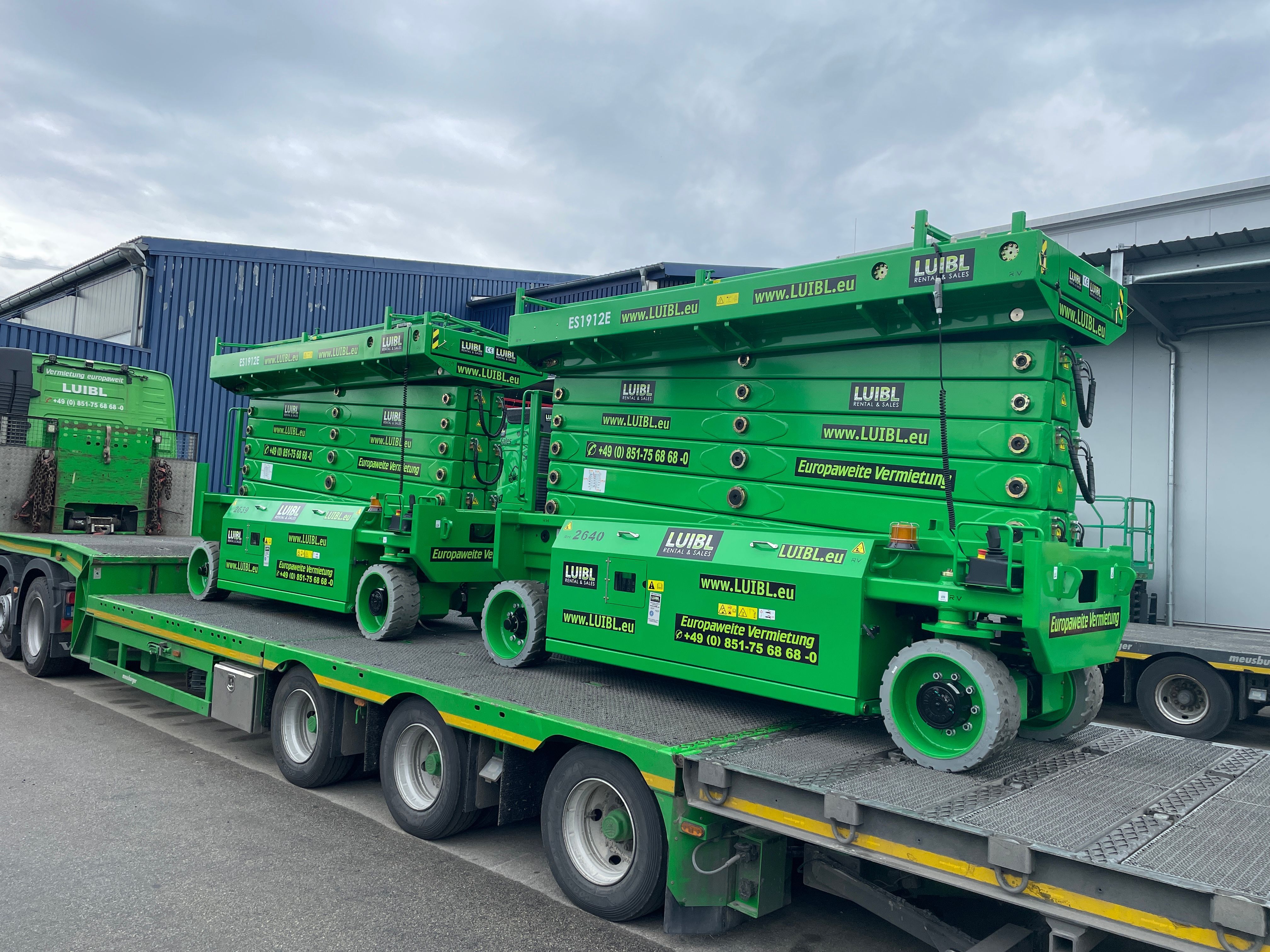
Anyone planning to renovate a church soon realises that this is no ordinary construction project. Between listed facades, narrow churchyards, delicate natural stone floors and towers that easily rise 40 to 50 metres, requirements arise that normal sites do not have. Choosing the right aerial work platform for church renovation often decides whether a project runs smoothly or whether damage occurs that costs more than the renovation itself.
In this article we show which machine types are suitable for which areas of a church, what special requirements exist - and what to consider when planning the rental.
Why church renovations make special demands
A church is rarely an easily accessible building. The churchyard is often enclosed by a fence or an old wall, gravestones stand close together, and the ground often consists of historic stone slabs or natural turf with poor bearing capacity. At the same time, towers and roof ridges reach heights that push even large aerial work platforms to their limits.
Then there is heritage protection: facades must not be damaged, and contact and outrigger points must be chosen carefully. Inside, there are further hazards - historic floors, frescoes, stained glass and delicate furnishings.
Choosing an aerial work platform for church renovation is therefore not a standard decision. It requires a precise analysis of the area of use before the first machine rolls into the churchyard.
The most important areas of use - and which platform fits each
Church tower: working heights of up to 60 metres and more
The church tower is usually the biggest challenge. Depending on age and architectural style, towers reach heights of between 25 and 60 metres - sometimes even higher. Facade renovation, covering the spire or inspecting masonry and plaster require outreach without having to touch the tower directly.
Here, articulating boom lifts are the first choice. They combine great working heights (up to 58 metres) with outreach, so the basket can be positioned precisely without direct contact with the facade. The articulated boom allows work "over obstacles" – such as projecting cornices or ornamental elements – which is decisive on historic tower facades.
Important: the machine must be set up in a stable position. If the church grounds are tight or the ground is soft, check the ground bearing capacity in advance and plan load distribution pads if necessary.
Church roof: steep pitches and difficult ground
A church roof rarely has a uniform geometry. Naves, transepts, apses and choir areas create many different roof surfaces, each of which has to be made accessible individually.
Telescopic boom lifts with large outreach make sense here if there is enough space on the church grounds. On tight sites, articulating boom lifts are recommended, as they can be positioned even in narrow angles.
If the church grounds are on soft soil or lawn: always check the ground bearing capacity. Outrigger forces of modern articulating boom lifts can exceed 10 tonnes at individual points.
Facade and outer walls: precision without contact
The outer walls of a church are often made of natural stone or historic brick. For facade work – joint repair, stone cleaning, impregnation, painting – an aerial work platform is only suitable for church renovation if it can be positioned precisely.
Articulating boom lifts offer the greatest flexibility here. For low side sections (up to about 18–20 metres), scissor lifts on firm ground can also be an economical choice.
Church interior: vaults, frescoes and lighting installations
Even stricter rules apply inside a church. Mast lifts are the classic solution for interiors. They are narrow, light, free of local emissions and can be brought in through normal portals.
Spider lifts come into consideration when the church floor is uneven or access is via stairs. Their rubber tracks protect sensitive floors better than conventional tyres.
Bell tower and bell frame
Bell suspensions, the timber structures of the bell frame and tower clocks need regular maintenance. For exterior work on the bell tower, the same applies as for the church tower: an articulating boom lift with sufficient working height and outreach.
Special requirements on the church grounds
Access: Can the church grounds be reached by a low-loader? Is the gate wide enough?
Ground bearing capacity: Historic church grounds often have loose soil. Load distribution pads are not a luxury here, but a necessity.
Gravestones and planting: It must be possible to position the outriggers without causing damage.
Noise and exhaust emissions: Electric or hybrid aerial work platforms are a good choice for sensitive church surroundings.
Equipment overview: church renovation with an aerial work platform
| Area | Recommended machine type | Typical working height |
|---|---|---|
| Church tower | Articulating boom lift | 30–58 m |
| Church roof | Articulating or telescopic boom lift | 15–40 m |
| Exterior facade | Articulating boom lift, scissor lift | 10–30 m |
| Church interior | Mast lift, electric scissor lift | 6–20 m |
| Bell tower (outside) | Articulating boom lift | 20–50 m |
| Bell tower (inside) | Mast lift | 4–15 m |
| Difficult church grounds | Spider lift | 8–25 m |
Case study: renovating the spire of a Romanesque church
A parish in Bavaria needed to re-roof the spire of its Romanesque village church. The tower measured about 38 metres, the church grounds were tight, and a public footpath ran directly alongside. Fixed scaffolding would have meant weeks of assembly.
The solution: an articulating boom lift with a working height of 42 metres. The machine was set up and dismantled within one day. In this church renovation, the aerial work platform saved the client several weeks of construction time.
What to consider when planning the rental
-
Determine the working height exactly – do not estimate it.
-
Carry out a site inspection – check the ground, access and obstacles on site.
-
Plan the rental period realistically – long-term rental terms can be cheaper than several short rentals.
-
Plan the briefing – the operator briefing on handover takes place directly on the rented machine.
FAQ: aerial work platforms for church renovation
Which aerial work platform is suitable for a 40-metre church tower?
For towers from 30 metres, an articulating boom lift with a nominal height of at least 42–45 m is the right choice.
May an aerial work platform be set up on historic church paving?
In principle yes, but the ground bearing capacity must be checked in advance. Load distribution pads are essential.
How much does it cost to rent an articulating boom lift for a church renovation?
The rental costs depend on the machine type, working height and rental period. An enquiry with the rental company quickly provides clarity.
Can an aerial work platform also be used inside a church?
Yes. Narrow mast lifts free of local emissions or electric scissor lifts are suitable.
Do I need a permit for an aerial work platform on the church grounds?
A building permit is not usually required. For churches that are listed cultural monuments, the competent regional monuments office may be involved.
Church renovation with an aerial work platform – how to make the project a success
Church renovation with an aerial work platform requires the right preparation. Articulating boom lifts are the workhorse for the tower and exterior facade, mast lifts cover the interior, and spider lifts solve the problem of difficult ground on the church grounds. The Luibl Rental team is ready to prepare a specific quote for you.