Heavy-duty forklift rental: the practical guide for loads from 8 to 18 tonnes
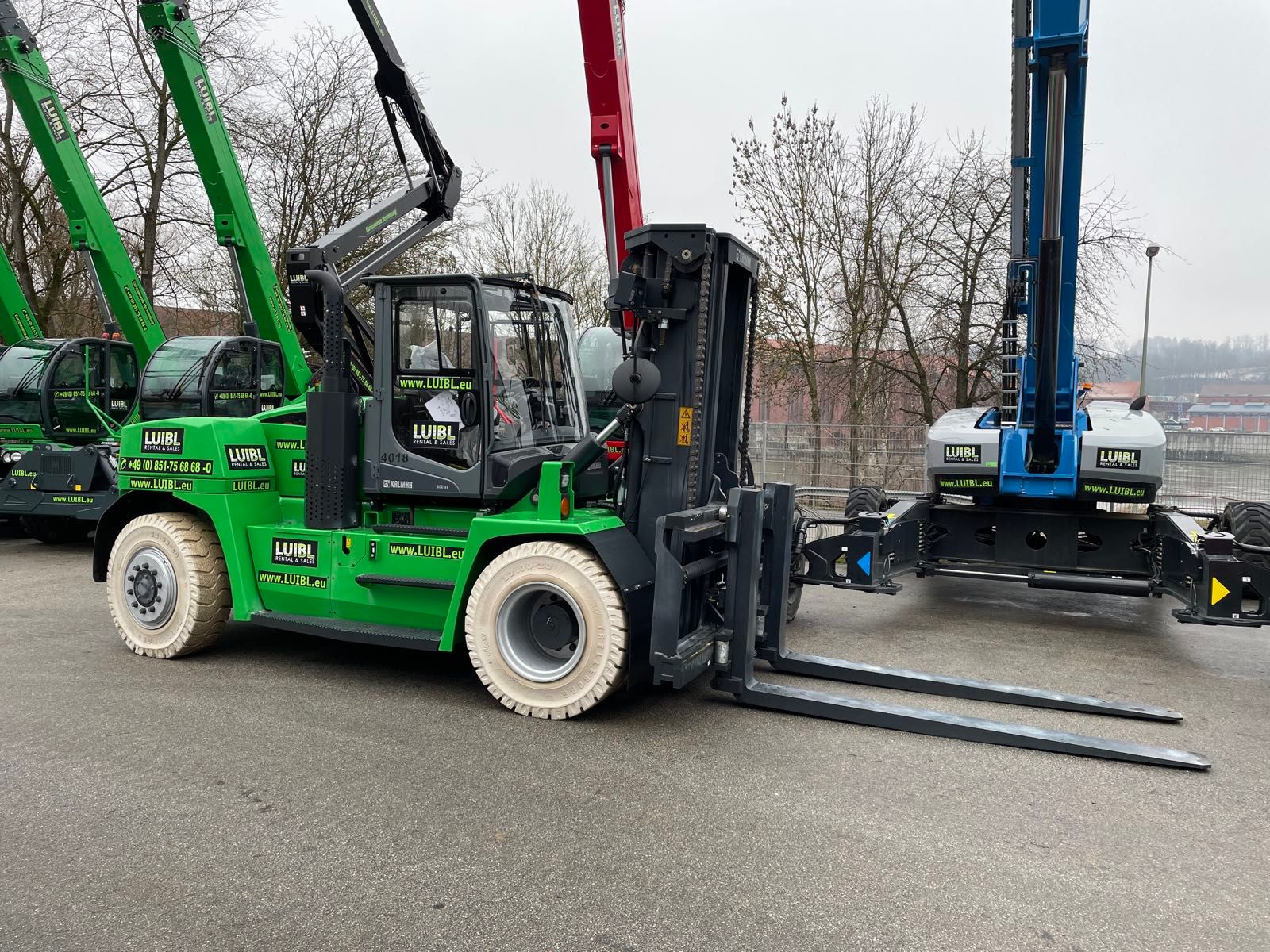
Anyone who has to set a 12-tonne machine transformer down on foundation bolts with millimetre precision has a problem no standard counterbalance forklift can solve. Classic industrial forklifts top out at 5 tonnes - above that begins a separate machine class with its own physics, its own logistics and its own risks.
This guide is aimed at logistics and production planners who need to know which technical parameters really matter before the machine is on site. The most common planning mistake is not too little load capacity, but a misjudged load centre distance. What looks like 18 tonnes on the data sheet is often only 12 in practice.
At Luibl Rental you can rent heavy-duty forklifts from Kalmar, Hyundai and EP with load capacities from 8 to 18 tonnes, in diesel and electric versions, with delivery throughout Slovakia by our own low-loader fleet.
Load centre and residual capacity: why 18 tonnes is not always 18 tonnes
The rated capacity on the type plate applies to a single reference point - the load centre distance (LC) defined by the manufacturer. For heavy-duty forklifts this value is typically between 600 mm and 1,200 mm. As soon as the actual load has a longer centre distance, capacity drops - in some cases drastically.
The principle in practice:
-
Kalmar DCG 180-6T: 18,000 kg rated capacity at 600 mm LC. Designed for compact, very heavy loads - steel blocks, press moulds, tools.
-
Kalmar DCG 160-12T: 16,000 kg rated capacity at 1,200 mm LC. Designed for large-format loads such as precast concrete elements or coils, whose centre of gravity is further from the mast anyway.
Anyone who orders an 18 t forklift because a 14-tonne load needs moving may be in for a nasty surprise if the load's centre of gravity is 1,500 mm from the mast. The residual capacity at lift height results from the machine's load chart - a curve showing how much load may still be moved safely at which LC and which lift height.
Before any enquiry, the rental company needs three values:
-
Load weight: the actual gross weight including transport frame and lifting accessories.
-
Load centre distance: measured from the fork face to the centre of the load mass. For irregular loads, the least favourable point applies.
-
Maximum lift height under load: because residual capacity decreases as lift height increases.
Based on these three values, the Luibl team advises which model in the rental fleet delivers the required residual capacity for the specific geometry. Anyone planning with rule-of-thumb values is planning the next logistics problem.
Indoor use: why electric heavy-duty forklifts are no longer a niche
In production halls with active manufacturing - for example in automotive, pharmaceutical or food processing - diesel heavy-duty forklifts run into real limits. Not primarily legal ones, but operational ones.
Three drivers for electric heavy-duty forklifts in the hall:
-
Emission control: even modern Stage V diesels with diesel particulate filters (DPF) load the hall air with nitrogen oxides and CO2. In multi-shift operation without opening the doors, levels quickly exceed internal limits. Ventilation systems would need upgrading - switching to an electric forklift is usually cheaper.
-
Noise reduction: a diesel heavy-duty forklift constantly produces 80 to 90 dB under load. Electric drives are 10 to 15 dB quieter. In halls with concentration-intensive work or constant foot traffic, this is a relevant occupational safety factor (applicable Slovak safety rules on noise protection).
-
Floor protection: electric heavy-duty forklifts come as standard with light-coloured, non-marking tyres. On coated industrial floors - epoxy resin, lithium silicate - this prevents black tyre marks that cost more to clean than the difference in rental price.
In the Luibl rental fleet: EP EFL 1002
The EP EFL 1002 is a 10-tonne electric counterbalance forklift with 5,000 mm lift height, designed purely for indoor use. Lithium-ion drive, opportunity charging possible, no gas or fuel handling, no exhaust emissions. For three-shift operations, the only forklift in the heavy-duty segment that runs without breaks or changeovers.
Worth knowing: the choice of electric heavy-duty forklifts above 10 tonnes is limited across the whole market. For higher capacities, diesel with a Stage V filter and controlled hall ventilation is the practical route, or the task is reassigned to a heavy-duty telehandler.
Logistics before logistics: what the forklift transfers to the hall
An 18-tonne forklift weighs around 25 to 30 tonnes even when empty. With a load, the total weight is 43 to 48 tonnes. Before the machine is even delivered, three points have to be clarified:
Point 1: Floor load capacity
The point load per wheel is given in the machine data sheet - for a loaded 16 t forklift it is typically between 12 and 18 tonnes per front wheel. Industrial floors in existing halls are often designed for 5 to 8 t/m2; special heavy-duty areas can take 15 t/m2 and more. Anyone who does not check this in advance risks floor cracks or settlement. On request, Luibl supplies the point load values of the requested model as a data sheet in advance.
Point 2: Factory gates and traffic routes
Heavy-duty forklifts are wide. The Kalmar DCG 180-6T measures around 2.5 metres in overall width, other models up to 2.8 metres. Factory gates under 3 metres become a bottleneck. The overall height with the mast retracted is 3.2 to 3.5 metres - relevant for hall passages and doorways. Turning circle: typically 4 to 5 metres, for heavy-duty models more like 5.5 to 6 metres. On sites with narrow aisles, this is the dimension that decides whether the machine can be used.
Point 3: Delivery by heavy-duty low-loader
Transporting a 25-tonne forklift is a logistics project in itself. Heavy-duty low-loaders, often with a special permit for the transport route, are the only option. Luibl operates its own low-loader fleet, which brings two advantages: agreed delivery dates without depending on hauliers and prompt replacement in the event of technical faults during the rental period. Delivery area: throughout Slovakia.
Accessories and attachments: what reduces residual capacity further - and why they are needed anyway
Every attachment shifts the load centre forward and reduces residual capacity. The data sheet for the forklift without an attachment is no longer meaningful at that point.
The most important attachments in heavy-duty operation:
-
Hydraulic sideshift: standard on modern heavy-duty forklifts. Allows the forks to be moved sideways by typically +/-100 mm without steering. Indispensable for precise positioning of press moulds or machine foundations.
-
Hydraulic fork positioner: changes the fork spacing from the driver's seat. With changing load formats (coils, large pallets, machine frames) this cuts changeover times considerably.
-
Fork extensions: standard forks on 8 t forklifts are between 1,200 and 1,500 mm, on 16 to 18 t models between 1,800 and 2,500 mm. Longer forks are needed for coils, large pallets or long goods - with reduced residual capacity, as the load centre is inevitably further from the mast.
-
Load backrest: essential for loose or unstable loads (steel bundles, bales) that could tip backwards.
-
Special-size forks: for steel blocks, machine foundations or special loads, a special fork geometry may make more sense than an attachment.
Before the rental enquiry comes the question: Which load, which format, which pick-up geometry? These three answers determine the right combination of forklift and attachment - not the other way round.
When the load exceeds 18 tonnes: heavy-duty telehandlers as an alternative
With load capacities above 18 tonnes or lift heights above 6 metres, the classic counterbalance forklift leaves its sensible operating range. The Manitou MHT 10200 in the Luibl rental fleet is formally a heavy-duty telehandler, not a counterbalance forklift - with 20,000 kg load capacity, significantly greater reach and the option of being fitted with a basket or winch.
When the heavy-duty telehandler is the better choice:
-
Lift heights above 6 metres: counterbalance forklift triplex masts end at around 7 m lift height; above that, stability becomes the limiting factor.
-
Reach in front of the machine: when the load has to be lifted over an obstacle (scaffolding, container, factory wall), the telescopic boom is unbeatable.
-
Tandem lifts for very heavy loads: two coordinated heavy-duty telehandlers with radio remote control replace a 200 t mobile crane in many cases - more flexible and immediately available for other tasks once the load is set down.
More on choosing between heavy-duty forklifts and telehandlers: see heavy-duty telehandlers in the Luibl rental fleet.
Rental terms, inspections and availability
Daily, weekly, long-term rental: daily rental for 10-tonne models starts at around EUR 200 excluding VAT, weekly and monthly rates are proportionally much lower. For long-term rentals of six months or more, Luibl calculates individual project prices including inspections, regular maintenance and in some cases a refuelling service. Inspection: every forklift in the Luibl rental fleet leaves the depot after an expert inspection in line with the manufacturer's instructions and applicable Slovak safety rules For long-term rentals, Luibl takes care of the recurring inspections during the rental period. Operators: the employer must ensure that forklifts are operated only by authorised persons with the required operator competence (forklift operator licence under Act No. 124/2006 Coll. and Decree No. 356/2007 Coll.). Luibl provides an operator briefing on handover - including the specific hazards of load centre shift and residual capacity. Service: in the event of technical faults during the rental period, Luibl sends a service technician directly to your site on request. For industrial customers with critical operating processes, framework agreements with individual service terms can be negotiated.
FAQ: heavy-duty forklift rental
- What load capacity do I actually need?
The rated capacity of the forklift must be higher than the load weight - how much higher depends on the load centre distance. Rule of thumb: with a load centre of 600 mm, a reserve of 10-15% above the load weight is sufficient. With a load centre of 1,200 mm or more, a reserve of 25-30% makes sense. Only the load chart of the specific machine provides a binding figure.
- Do I need a special licence for a heavy-duty forklift?
The forklift operator licence (Act No. 124/2006 Coll., Decree No. 356/2007 Coll.) confirms operator competence for forklifts. For heavy-duty forklifts, the employer additionally requires a machine-specific operator briefing, which the rental company provides on handover. We recommend documenting the briefing in writing.
- Can a heavy-duty forklift with a diesel engine be operated indoors?
In principle yes, provided the hall ventilation is adequately sized and the Stage V machine is equipped with a diesel particulate filter (DPF). For multi-shift operation or halls with active production, electric drive is the more robust choice. A risk assessment under Government Regulation No. 392/2006 Coll. (work equipment) should be carried out before use.
- How quickly can Luibl deliver?
Subject to availability, we deliver throughout Slovakia at short notice. We confirm a specific delivery date once the model, rental period and delivery location have been clarified.
- Do you offer rental without an operator? With an operator?
The standard is rental without an operator - the renter provides qualified operating staff. On handover, we provide a machine-specific operator briefing.
Next step: a specific enquiry instead of a list price
Heavy-duty forklifts are not standard goods that can be ordered from a catalogue. Load weight, centre of gravity distance, lift height, floor load capacity, door clearance dimensions, drive type and rental period result in an individual configuration for every project.
What Luibl needs for a binding recommendation:
-
Load weight (gross, including lifting accessories)
-
Load centre distance (measured or estimated with a limit value)
-
Maximum lift height under load
-
Place of use (indoors, outdoor area, mixed)
-
Floor load capacity at the place of use (if known)
-
Rental period and delivery location
With this information, the Luibl team will promptly prepare a specific quote with a model recommendation, residual capacity analysis and delivery date.
→ Request a quote | View the heavy-duty forklift rental fleet
Related topics in the Luibl rental fleet
-
- Forklift overview: diesel, electric, LPG - standard forklifts up to 5 tonnes for warehousing and logistics.
-
Diesel forklifts up to 18 tonnes - details on torque converter vs. hydrostatic transmission and tyre choice.
-
Heavy-duty telehandlers up to 20 tonnes - an alternative for heavier loads or lift heights above 6 m.